The First PC to Die, Ever.

Author: DHBoggs /

 According to Dave Arneson's Corner of the Table newsletter, Vol. III, #4

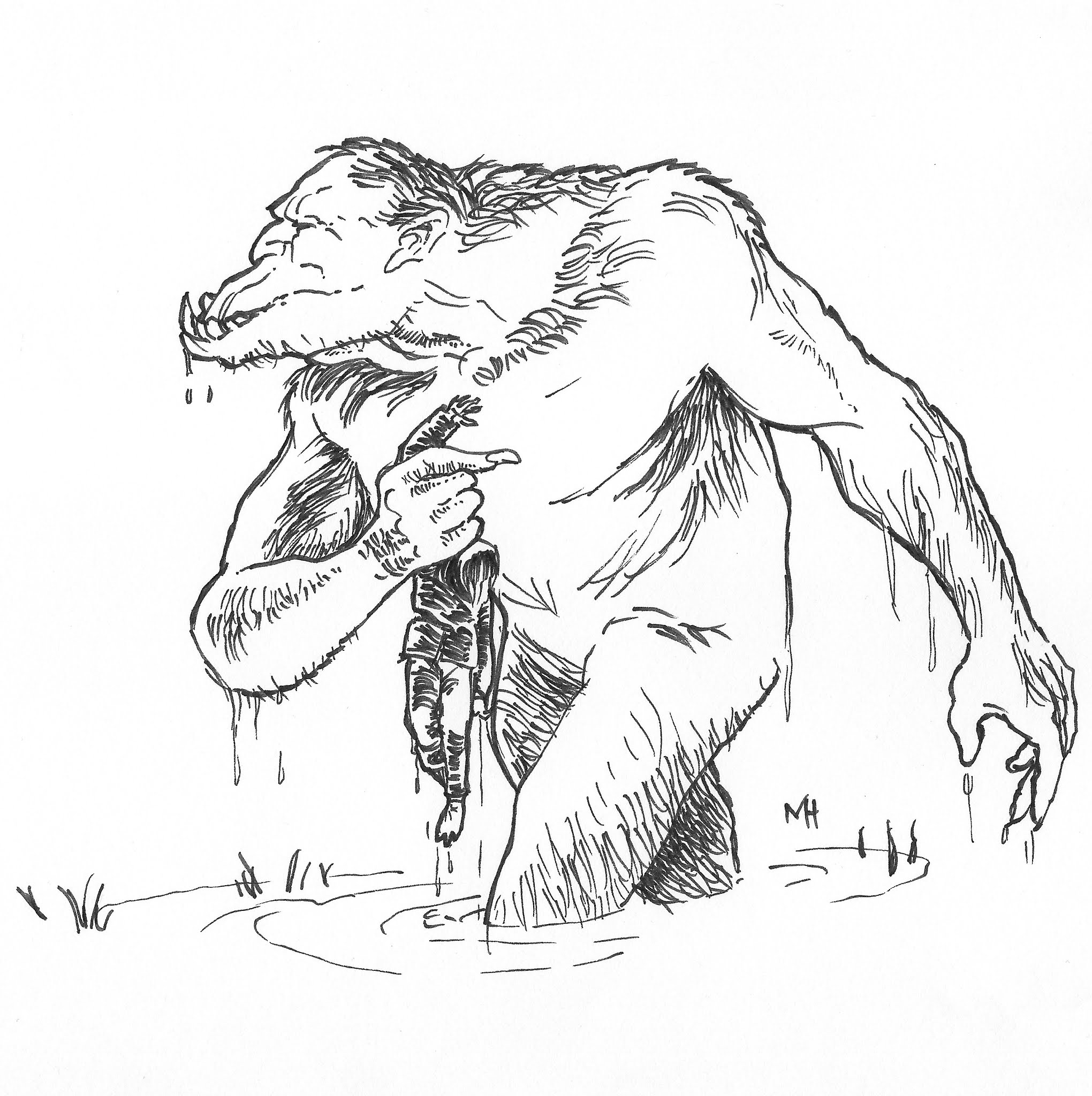
"There will be a medevil "BRAUNSTEIN" April 17, 1971 at the home of David Arneson from 1500 hrs to 2400 hrs with refreshments being available on the usual basis. Players may come at any time and any number are welcome to attend what should prove to be an exciting time.  It will feature mythical creatures and a poker game under the Troll's bridge between sunup and sundown."

Of course, this is only an announcement, but we have no reason to think the game did not take place as planned.

That game, you may note, therefore took place 50 years ago to the day this essay is being posted.  Was it the first ever Blackmoor game with Player Characters engaged in a tabletop medieval fantasy adventure?   Or maybe another way of asking that, was it the first game of what we would now recognize as a kind of "D&D"?


There is a very good chance the answer is yes.


Our earliest record tied conclusively to Blackmoor is the Northern Marches map the Areneson mailed to Rob Kuntz in March of 1971 - just weeks prior to the Troll Bridge poker game.  To recap briefly, that map accompanied a letter introducing Arneson's Northern Marches campaign.  He also mentions 4 players (Duane Jenkins, William Hoyt, Edward Wernecke, and Marshal Hoegfeldt) from whom he apparently had commitments to play, as stated in the letter: "The area known as JENKIN’S LAND is ruled by Sir Jenkins while Bill Hoyt rules Williamfort, Ed Werncke rules Swampwood, Marshall Kieston."

Bill Hoyt, from whom we have the map, has made it clear that the campaign as planned in the letter never happened and he played in no games there.  What we are seeing with the letter and map to Kuntz is Arneson's initial planning, at a time before he has a copy of CHAINMAIL with its Fantasy Supplement.

As far as we know, of these persons mentioned only Jenkins actually played in Blackmoor during the pre-D&D period.  Marshall Hoegfeldt very shortly got kicked out of the group, and Bill Hoyt decided to join the Gregg Scott/Randy Hoffa group, and all of them got written up as the "Infamous Characters" Marfeldt the Barbarian, Lord WhiteHead, The Egg of Coot and the Ran of Ah Foo. (Note that later, after D&D was published, Bill did finally play in Blackmoor.)


Within  a few weeks then of sending his Northern Marches map to Kuntz, Arneson places the notice in COTT for the for the "medieval Braunstein" Troll Bridge Poker game.

The next issue of COTT, (Vol. III, #5) promises the start of "reports from the Black Moors" medieval setting and announces another medieval game on May 22, after the general meeting. This is the meeting where Dan Nicholson received the Spanish Royals character sheet. 

The picture emerging with the two COTT entries and the March letter to Kuntz, is of the initial development of a new campaign, not even yet "officially" named Blackmoor until the May entry.  The picture is further reinforced when we consider that the first Blackmoor experience remembered by several of the Blackmoor bunch is an adventure that takes place seemingly after Arneson returns from a European vacation in mid July.  This would be the "Icelandic Cave" adventure I've mentioned in previous posts wherein Dave's players are on a mission to find none other than Dave himself, after his plane crashlands in Iceland apparently on its way back from his trip to Europe. and somehow Arneson stumbles through a cave there into the land of Blackmoor.


What game, if any, may have taken place on May 22 isn't clear, possibly it was the first Castle/Dungeon game inspired by a monter movie binge that Arneson reported so often (see here for related discussion) but in any case it seems the players involved in the Icleandic Cave adventure don't recall the earlier Troll Bridge game in April - probably because they weren't there.  Arneson's basement was a veritable revolving door of games and gamers and people showed up when they could.


Nevertheless, there is one gamer who remembers the Troll Bridge Game, or at least what he remembers certainly seems to be that game.  That player is Bob Meyer, whom many of my readers may know as the person who took over as Game Master of the Blackmoor campaign after Arneson's passing. Bob has recounted his initial and brief encounter with the land of Blackmoor several times, most recently in the Secrets of Blackmoor documentary.  I won't repeat the whole story, but here is some of what Bob has to say about it:

"I was in the game that had that troll, and I did not care for the rules. The troll killed me in no time at all, and I was a hero! I refused to have anything to do with Blackmoor for a very long time after that."

"I claim to have the first character killed in Blackmoor. How is that for a claim to fame?" From The Comeback Inn Forum


Claim to fame indeed.  Fifty years ago today, Bob the Hero appears to be the first of a very long line of PC's in our beloved hobby to die fighting monsters. 


Fifty Years of Fantasy Role Play Table-top games.

Author: DHBoggs /

 Today marks an interesting, possibly momentous, anniversary.  It has been 50 years since the Boris Karloff movie The Black Room aired as part of a double feature with Werewolf of London on Channel 5's Saturday run of Horror Incorporated in the Twin Cities.  

This marks the second time that the Minnesota station had shown The Black Room, but it may be the most significant.  Lets take a step back and remember what Dave Arneson said:

"Some months after Mr. Wesley left, a local TV station had on several old monster movies, which I watched while eating popcorn and reading old Conan novels. It was then that Blackmoor Dungeon was first conceived. Starting with a few sheets of graph paper, the upper levels took shape. The next week was spent laying out my wargaming table to represent the castle and countryside around Blackmoor."  Wargaming #4 Jan/Feb 1978

The quote above is perhaps the oldest telling of a tale told many times, with much the same detail.  He could never seem to remember the exact books he read or movies he watched, but it seems far to great a coincidence that the pun-loving Arneson called his land the Black Moors in his May 1971 Corner of the Table Newsletter Vol 3 #5, at a time when The Black Room had already aired twice on his beloved Horror Incorporated (January 16, 1971 and February 20, 1971).

So why am I calling particular attention to the February 20 showing?  We have talked before about the Northern Marches map and accompanying letter Arneson mailed in March of 1971 to Rob Kuntz as king of the Castle & Crusade society.  This letter represents the earliest datable record connected directly to Blackmoor.

It is also a matter of only two or three weeks after the February 20 showing of the The Black Room that Arneson mailed this letter.

It's the closeness of the Feb 20 airing date to the composition of the letter that makes me wonder about the precise details of Arneson's genesis story.  Mind you, I'm only speculating, but what if, in trying to call up how he started the whole thing some 7+ years afterward, Arneson muddled it a bit.  What I'm suggesting is that watching movies and reading Conan novels inspired the creation of Blackmoor, just as he said, but perhaps it wasn't the dungeon maps he drew that first weekend, but the Northern Marches map sent with the letter to Kuntz?  Perhaps the dungeon maps came a few months later, as seems to be the case from the scant records we have.

There is another hint in the letter itself suggesting this may be the case.  In telling his story Arneson always made sure to point out the influence of Conan novels.  Looking at the early descriptions of Blackmoor Castle, village, and dungeon, there is nothing suggesting a connection to Conan or the Hyborian Age.  We could suggest that those initial connections were lost, overwritten by the Tolkienesque material of Chainmail, but that seems at odds with Arneson's habit of recycling gaming ideas.  We'd expect those hints to still exist in the dungeon if ever they were there.  However, when we turn to the short March 1971 letter to Kuntz accompanying the Northern Marches map, we see a different picture:

"...to the east lay the forested domains of the ERAKS, a breed noted for their cunning and banditry. To the North lie the domains of the SKANDANARIANS, a savage band of sea raiders whose ferocious nature brings them into constant conflict with all their neighbors. To the [northwest] lie the accursed lands of the unholy RED WIZARDS COVEN, whose lands are more dangerous than even the wizards themselves. Finally, to the west and south west lie the lands of PICT'S, a savage band of uncivilized barbarians noted for their cruelty and fierce loyalty to the abomination they call king."

The influence of Conan on the Northern Marches map is abundantly clear in that paragraph.

Whether The Black Room really had anything to do with the genesis of fantasy roleplaying games or not, or whether it was really the Northern Marches map and not dungeon maps Arneson drew after his movie, novel, and popcorn binge,  there is one thing we can say with absolute certainty: by March of 1971, David Lance Arneson had created the idea for a game that would change the cultural landscape of planet Earth.


For more fun on movies and the genesis of Blackmoor, have a look here: More Thoughts on the Cinematic Influence


Education for Character Variability

Author: DHBoggs /

 A complaint voiced toward OD&D and traditional D&D in general is that characters are all the same, whereas "modern" games offer a delicious variety of options for customizing and "building" characters.  Dave Arneson echoed these sentiments in a radio interview:

A lot of the changes between second edition and third edition are actually changes in so far as what I originally wanted to do with the (game) system. For instance with the different classes and the different fields you could learn. I wanted to do that originally, but it was considered too complicated and people couldn’t handle it. Well now that’s come back, you can do that. You could really make a unique character class with the variability; and I always wanted to do that and I do that in my original campaign even today…. Because the players in the original campaign could learn different skills and different abilities, virtually everybody who was a fighter also wanted to be able to throw magic.  And it seemed like everybody who was a magic-user also wanted to be able to fight.

Dave Arneson, Mortality Radio interview, July 9th, 2004.

Back in the day, Arneson's solution for being able to "really make a unique character" was to create an education process where characters could learn the things they needed or wanted.  We can see the roots of his thinking on education in how he initially set up his mechanics for learning spells:

"Progression reflected the increasing ability of the Magic user to mix spells of  greater and greater complexity. Study and practice were the most important factors involved. A Magic user did not progress unless he used spells...  So to progress to a new level, one first learned the spells, and then got to use that spell."

Breaking this idea down generically, a character could progress in "class" skills through learning and subsequent successful practice.

It was an idea that could be applied to much more than magic.

Arneson took it further in his collaboration with Richard Snider, the Adventures in Fantasy ruleset.  He described his thinking in an interview in Pegasus 1:

"I also wanted to get in something on educating your character so one could learn different skills."

Interestingly, while Gary Gygax developed the AD&D system along the rigid class based lines we are all so familiar with, when writing his Gord the Rogue novels he described his protagonists growth very much in keeping with an education based method.

Gord doesn't develop his abilities naturally as a consequence of leveling up and gaining XP.  Initially, Gord is a nothing, but he spends several years learning to climb, pick locks, hide in shadows and so on in a sort of boarding school under the tutelage of master thieves,  Later, he seeks out and hires fencing masters to learn fighting skills and he spends time with Rhenne acrobatics instructors learning tumbling, jumping, juggling and so on.

In game terms Gord begins on the thief class and then becomes a fighter/thief and fighter/theif/acrobat.  The class system as it evolved in D&D is all very complex and all very artificial, and all very uniform.  For Gord, that uniformity is strange, because the novels present him as a uniquely individual character learning his new skills one at a time under instruction.  No doubt, most players want their character to be just as individualized as Gord, so shouldn't they be able to learn through schooling just as Gord did? 

Some may argue, as Arneson was implying in the opening quote, that contemporary games offer character individuality to players as part of their class structure.  However, it has been pointed out more than once that such character customization is largely illusory since players in particular classes are given particular options which often result in players choosing the same "best" options that most other players choose.  The design pressures of today's games funnel players to create very similar "individual" characters.  

Furthermore, because the characters choices occur automatically at certain stages of the game - usually when leveling up, flexibility to craft the character in unique ways is limited.

A character with something like all of Gord's abilities and variability could be better modeled through an education system within 3 broad and encompassing classes - the original three - Fighter, Cleric, Magic-user.

Gord is obviously not a cleric or MU, so he is a fighter.  Using the money he got from thieving, for example, Gord sought out fencing instructors of a particular sort and this particular training can be reflected in his character sheet through education. 

To be clear, what I'm advocating here is something more than a skill system.  This idea is a bit more radical and it is simply this: 

ANY ACQUIRED FEATURE, BONUS, SKILL, ABILITY, POWER, FIELD OF KNOWLEDGE, OR DEVELOPED TRAIT AVAILABLE AS A BENEFIT OR OPTION OR ATTRIBUTE AT ANY POINT IN ANY CHARACTER CLASS, SUB-CLASS, OR PATH IN ANY VERSION OF D&D, CLONE, OR VARIANT OF ANY SORT CAN BE REPLICATED AND LEARNED THROUGH AN EDUCATION PROCESS.

Sorry for the all caps, but it's a fairly radical thesis.  The only exception to the above statement is abilities that require the character to be of a certain nature that they aren't.  A human can't learn to flap their arms and fly like a bird or self immolate on command like a balrog, but they can learn to kick open doors like a monk or assess the value of jewels like a jeweler.  Likewise a Magic- user can't learn to turn undead like a Cleric, but they could learn to backstab if they wanted to.

For how this might work, we can look to the ideas in the AiF education system and see what might be gleaned from there for a D&D game.

Sure, folks can adopt wholescale the education system in AiF or for that matter, some other rule set, but these tend to be fiddly and specific, whereas what we need is a ruleset that will cover any characteristic we want a character to acquire. 

The first thing to note about AiF's education system is that it isn't simple.  Not surprisingly, it is designed to fit a particular system.  It also attempts to "realistically" asses how hard it will be and how long it will take to learn each particular subject and a laundry list of subjects is provided, each with it's own statistics.

Characters are assigned a formula to asses how well they can learn, that is based on the presumed difficulty of the subject and the length of time spent studying and the character's Intelligence score.

For a game, the simulationist approach taken in AiF is really overkill.  We really don't need to do all that. Instead, we can take the basic principals that Ability Scores and practice time are key factors and rather than guessing this and that length of time for this and that subjects, an average learning time will work just as well for game purposes.

So here is one method to recommend.  For any thing a character wants to learn or any skill they wish to acquire, I assume it will take them a number of months of continuous study to master.   The number of months is equal to 20 minus their Intelligence score for any cerebral subject, or minus their Strength score for any purely strength based activity, or minus their Dexterity score for activities requiring a steady hand and a quick eye.

A character with an 18 Dexterity could learn to pick pockets efficiently in a mere 2 months, but a character with an 8 intelligence would take a year of dedicated study to learn a new language well enough to carry on a street conversation.  Some negotiation between referees and players is inevitable, but will also ensure that each character will truly have their own unique qualities.

This method is very flexible and you can add layers of expertise and skill to any subject.  A character might learn basic cooking skill and then go on to expertise in orc cuisine, for example.

You could apply this method to weapon specialization rules or technical skills, to going berserk or learning to heal - anything.


Greyhawk Timeline According to Gord

Author: DHBoggs /

 When the original Greyhawk folio was published, the default date for the setting was Common Year 576.  Since then the setting date has been continually advanced through various publications.

Among the first to advance the date was The Greyhawk Wars, a product which has had a somewhat contentious reception, in part because it was published after Gygax's ouster from TSR and did not have his blessing.

Interestingly, Gygax himself also continued to advance the Greyhawk timeline, both in Dragon Magazine articles and in his Gord the Rogue novels.

Below is what can be cleaned of the political machinations ongoing in Greyhawk according to details from the Gord series of books.

Surprisingly, while a lot of folks have given thought to various parts of the timeline, including most notably the esteemed Eric Mona, I have yet to come across anyone who put it all together as I have here.  

(Events of Saga of the Old City)

552/3 CY:  Flocktime: Gord Born. 

576 CY: Small naval battles erupt between the Rhennee and Duke Karall of Urnst.

578 CY: The Horned Society occupies the Bandit Kingdoms of Warfields and Wormhall.

578 CY: (Sunsebb 1) The Battle of Woodford. A twelve thousand strong Aerdian army led by Grand Marshal Dreek bent on invading Nyrond through the Adri forest pushed back at the Harp river. 

(Events of Artifact of Evil).

579 CY:  The Horned Society wages war against the Bandit Kingdoms.  The war is ongoing and in stalemate. (p95)

The Scarlet Brotherhood and the Horned Society act in concert as allies. 

580 CY:  The principality of Ulek attacks and conquers Strandcastle Keep in the Pomarj - a bastion held by the Scarlet Brotherhood. (Chap 1&2)

Iggwilv frees Zuggtmoy from her prison in The Temple of Elemental Evil. (p. 330)

A large army of Pomarj monsters under The Scarlet Brotherhood moves through the Suss and Welkwood forests, harried by elves and woodsmen.  The force attacks Celene, and are defeated in a battle that lasts 2 days. (p231)

Iuz Moves against the Hierarchs of the Horned Society.  Blackmoor, the Hold of Stonefist, and the Bandit Kingdoms ally with him.  (188-189)

An Army of Iuz under the command of the wizard Lord Ormuz is ambushed in the Vesve Forest and defeated by an army under the command of the wizard Mordenkainen. (chap29)

Iuz conquers Molag, subjugates the Horned Society, and begins construction of a new palace in Molag as winter sets in.

Iuz is now the self-titled Emperor of Evil and Lord of Pain. He receives tributes and offers of alliance from all of the Bandit Kingdoms, the Hold of Stonefist, and factions of the Wolf and Tiger Nomads. (p. 343-44)

*581 CY: (Events of Sea of Death)

*582 CY: (Events of Come Endless Darkness)

Iuz, assisted by by Iggwilv and Zuggtmoy, launches a massive, multipronged, attack.

Iuz takes control of the Vesve, and the lands west and south to the Velverdyva, but is stopped at Chendl.

Iuz captures the territories of Furyondy north of the Crystal River, and the Shield Lands excepting only the capital island.

The Bandit Kingdoms and the Rovers of the Barrens acting under orders from Iuz, overrun the Duchy of Tehn.

Iuz directs the The Hold of Stonefist to attack the Theocracy of the Pale. Urnst holds. Highfolk holds.

The Great kingdom marches against Nyrond, Almor, and the Iron League.

The Bakluni fight the nomads to the North and South and come to a stalemate.

The Scarlet Brotherhood in the Pomarj attacks Celene, Ulek and Urnst.

*582/3 CY: (Events of Dance of Demons)

The Great Kingdom is in a state of civil  with both north and south provinces allied against Ivid. Medegia is also in open rebellion.


* These dates are not possible to nail down precisely through internal chronology in the novels.  While Gord's age is stated in several instances, his journeys into and on other planes make his age greater than it would be by an unknown number of years had he remained in Greyhawk.  This is made explicit in Sea of Death where it is stated that he appears to be merely 20 years old (p55) but is actually at least 28 (p58). Edit: Jason Zavoda has recently determined Gords birthyear must fall between 448 and 552 and since DoD has Gord being 30 the 581-583 dates follow, being shortly after the events of AoE.   Gord is only about two years older than the 28 he is said to be at the Start of SoD.   These dates also roughly match the published Greyhawk Wars dates.

Interestingly, while the Greyhawk Wars unfold differently in the TSR publication, the end results are much the same.  It may be worth a post attempting to harmonize the two...

Obscure Mythical Monsters

Author: DHBoggs /

I don't often indulge in creating new monsters, but over the years I've put together a few here and there.  Some of these I briefly published elsewhere, but they haven't seen the light of day for a decade, and others I just found in a recent perusal of old papers.

In my anthropology work I have had exposure and access to a range of mythologies from people and places not well known (or known at all) by the general public, and a few of these are drawn from such obscure origins. 

Stats are either Basic or AD&D, according to what I was playing at the time.  Adapt/adopt as you please.  Art is courtesy Michael Hill - rights reserved.


Aswang   Varieties - Mananaangal, Penanggalan, Nukekubi

 Armor Class 9
Hit Dice: 2
Move: 9"
Attacks per round 1
Damage – 1d6 + sleep inducing bite.   

Aswang are young female blood sucking infected undead.   Due to their limited magic powers, Aswang are often described as a combination of vampire and witch.  Aswangs are able to change their appearance, normally appearing as shy but typical females (although they usually have bloodshot eyes and unusually long tongues), but changing at night to ghoul like creatures that enjoy eating unborn fetuses and small children, favoring livers and hearts in particular.  Some even grow long proboscises, which they use to suck children directly from their sleeping mothers' wombs.   Aswangs will also suck the blood of males they find attractive – about a pint at a time, but it is usually not their preferred meal.  

The bite of the Aswang injects a sleep inducing drug.  The victim must make a Constitution Save to avoid going to sleep in one round.

Aswangs also have limited spell casting ability - they can cast 3 Charm spells a day.

Aswangs live no longer than normal humans.  Those who have reached the age of 40 transform into Mananangal.   Despite being older females, Manananggal are quite beautiful.

The Mananangal gains an additional Level Dice but is identical to Aswang most of the time.  However during the full moon, the Mananangal is able to split itself in half and fly through the air to hunt for victims.   The head and shoulders, ofthe Mananangal flies through the sky using huge bat-like wings, while the attached entrails (heart, lung, liver, intestines, spine.) glow and sparkle like fireflies

The lower torso is left in a secluded lair for safety.  While the head, neck and organs are detached, the torso becomes inanimate, standing like a headless statue.  Of the Mananaangal's two halves, the lower torso is thus the more vulnerable.  It is said that if one finds this torso and either sprinkles salt or sand on it or burns it, the Mananaangal will die with the coming dawn.

An aswang/manananggal can be revealed by using a bottle of a special oil extracted from boiled and decanted coconut meat and mixed with certain plant stems upon which special prayers have been said.  When an aswang comes near or roams around the house at night, the oil is said to boil (or froth into bubbles) and continue boiling until the aswang departs.

 Behind the Curtain:  Variation of this monster are common throughout southeast Asia and rural japan.  Although it has been written up elsewhere, this version takes a deep dive into several related mythologies, particularly those of differing regions of the Philippines.

Glory Hand

Frequency: Rare
 # Appearing: Solitary
Armor Class: 7
Move: 12", can hop 15 feet.
Hit Dice: 2 +2
% In Lair: none
Treasure Type: nil
Attacks per round: 1
Magic Resistance: Immune to Fire, Cold, Sleep
Intelligence: Average
Alignment: Neutral
Size: 5' 4" long
Damage – 1d6

A Glory hand is a severed human/humanoid hand cut from the victim of a violent death and animated by necromancy.  Although greatly restricted in many ways, the small size and great mobility of the glory hand has a great many uses, being able to get in almost anywhere, unnoticed.  The hand will usually obey it's master, whoever it understands that to be, but can act on its own accord.

 Behind the Curtain:  The Glory Hand is a late medieval/early modern folk tale found in england.  Of course it is a familiar trope.


Hafgygr

 # Appearing: 1
Armor Class: 2
Move: 13"
Hit Dice: 4
% In Lair: 16%
Treasure Type: A
Attacks per round: 1
Magic Resistance: High
Intelligence: Low
Alignment: Chaotic Evil
Size: 7' tall
Damage – 4d8 or weapon

Shaggy, amphibious giants standing twice the height of the average man, Hafgygr have large jaws with sharp teeth, sharp hard nails, and very tough hides.  They are cold blooded and live in swamps and lakes, often raiding more civilized areas for prisoners and food.  Hafgygr are aggressive, selfish creatures who seethe with hatred toward any perceived slight or wrongs, and being notoriously territorial, they will attack anyone who trespasses, wittingly or not.  Hafgygr disdain the use of weapons, preferring to rend and pummel their victims or simply scoop them into their great, deadly maw.  Nevertheless, magical arms and armor are often found in their treasure.

Behind the Curtain:  Half-Gygr literally means half giantess in old Norse, meaning a creature who's mother was from the realm of the giants and monsters.  The description here is based very closely on that of the monster Grendle in Beowulf. 
 

Hoyauk

 Armor Class 8
Move: 9"
Hit Dice: 6

The Hoyauk is a giant water serpent with a pointed shark like snout and slim head and tail.  It also has long, wing like fins with which it can sail up to 100 feet through the air.  It frequently launches itself through the air in this fashion to catch large birds of prey hovering near the waters or hunting for fish.  It also attacks people in open boats in the same manner.  Hoyauk have a terrible stench, and exhale a caustic gas that causes burns and blisters to anyone standing within 10 feet of its head.  The stench can cause vomiting (+3 on Saving Throw) and the breath does an automatic 2 points of damage per turn on exposed skin. 

 Behind the Curtain: The hoyauk is a traditional monster of the tribal Ainu people on  the island of Hokkaido.

Jimru

 Armor Class 5
Move: 12"
Hit Dice: 6
% in Lair: 16%

The Jimru is a large, dangerous and cunning beast the size of a large bear, and vaguely similar in appearance, although the head is shaped more like that of a tiger and the tail resembles that of an elephant with the tuft at the end being made of quills, not hair.  The overall color of the Jimru is also an elephant like stone grey.  The creature is covered, porcupine like, with quills instead of fur.  These quills are barbed so that any bare flesh that touches them will very likely be impaled and stuck.  The Jimru often catches prey this way.  It is capable of relaxing the musculature that holds in the quills at will so that it can detach a stuck creature at leisure – after it has been killed by the Jimru’s deadly bites, usually.

Behind the Curtain: The jimru is a greatly feared monster of the native people on the Andaman islands in the Indian ocean.

Snow Serpent

Climate:  Cold
Frequency: Very Rare
 # Appearing: Solitary
Armor Class: 6
Move: 9"
Hit Dice: 10
% In Lair: 90%
Treasure Type: nil
Attacks per round: 1 
Special Attack: Constriction: 3-30 HP per round
Magic Resistance: Standard
Intelligence: Animal
Alignment: Neutral
Size: 7' 10" long
Damage – 1d10

This furred, white snake burrows itself in mounds of snow near mountain trails from which it will ambush passers by.  The serpents are entirely carnivorous, and have been know to eat anything up to the size of a bear.  Creatures too large to swallow whole are chewed into manageable pieces.  Snow Serpents live a solitary, wandering existence, staying in one place only until they feed, after which they move to a new snow mound in a new area.  The single exception to this habit is that a pregnant Snow  Serpent will burrow deep into a snow mound to create a nest, where she will remain untill her eggs have hatched.  The fur of a snow sertent is rare and highly valued. 

Behind the Curtain:  When I was very young my father managed a ski resort (Bear Rocks, Pa) and the workers there used to tease newby customers about watching out for the snow snakes that liked to hide in the moguls.

SPIRIT RAVENS

AC: 2, M: 1"/48", HP: 14, #ATT: 1, DAMAGE: 1-6, SPECIAL ATTACKS: can steal the spirit of the dying, SPECIAL DEFENSE: Teleport, MAGIC RESISTANCE: 75%, ALIGN: Neutral Evil

Spirit Ravens are indistinguishable in appearance from normal ravens but they are much tougher and more intelligent.  They are capable of carrying spirits from place to place and are employed by some gods to steal spirits from others, especially during battles.  The ravens have the ability to teleport from plane to plane and from place to place within a plane.

Spirit Ravens will often wait when they anticipate death in the hopes that they can steal a spirit.   Naturally, people take the sight of a raven as an ominous sign.

It is believed that these ravens can be called upon by exceptionally strong casters  or to simply spy and report back or even to transport a the caster's spirit from plane to plane.  A spirit and  spirit raven thus bound together are each affected by damage suffered by the other.  If the raven dies the spirit will cease to exist and vice versa.  

Trows

Frequency: Rare
 # Appearing: 2-14 (4-30)
Armor Class: 4
Move: 13"
Hit Dice: 4
% In Lair: 40%
Treasure Type: A
attacks per round: 1
Magic Resistance: Standard
Intelligence: Low
Alignment: Chaotic Neutral
Size: 4 1/2' tall
Damage – 1d6 or weapon

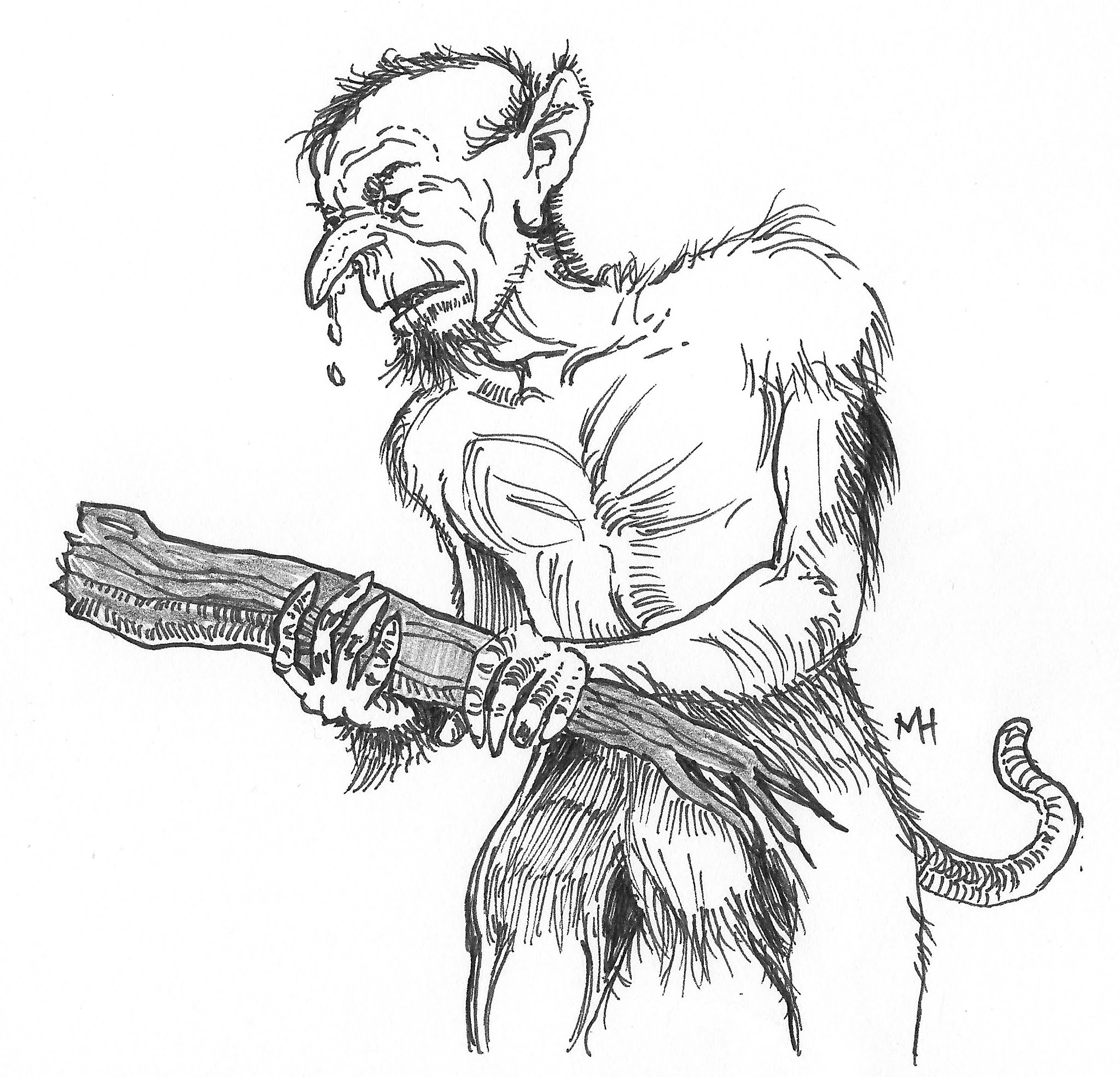
Trows are horrid fairy creatures found in cool, and damp climes.  They stand about 4 ½ feet tall on average and are very ugly, being covered with thick, greasy, flea infested green black hair – the older the trow, the darker the green.  They have long, snotty noses, big ears, a short tail and peach colored skin.  Trows stink.  They love to eat or wreck – in that order – everything they chance to find.

Trows speak crude common, prefer to dwell in caves, and are good swimmers.  They have infavision up to 60',

Trows take such bad care of everything they find that capture weapons and tools are soon ruined from corrosion, but they can bite and claw effectively.  They will use hand weapons should they happen to have them, but rarely will a troll bother to carry more than a spear or a knife when traveling.  Trows love to set up an ambush, and will always do so if given a warning that an opponent (just about everybody) is coming.  They also love to hide under dark bridges and demand a toll of passers by.

Trows, will occasionally kidnap a human baby to raise as a slave, sometimes leaving a sickly trow baby in its place.  Trows also love to torture small creatures and other huldufolk for entertainment.

Older Trows are capable of brewing a concoction that affects them with symptoms much like that of alcohol consumption for humans.  Should any of this potion of Trow Strickening come into contact with the flesh of any creature not a trow, that unfortunate must make a Saving Throw at -2 or be paralyzed for 1d4 turns and develop an itchy rash for 24 hours. 

Society – Trows live in small, matriarchal family groups – usually 2-10 individuals.  The “Mama” of the group rules with an iron fist.  She is very protective of her “babies”.

Ecology – Trows dwell exclusively in caves.  They are omnivorous and none to picky eaters, being immune to most poisons and diseases.  Eighty percent of all Trows are male.  Trows cannot tolerate sunlight.  If a Trow is caught in the light of the sun it will be Earthbound until the sun sets.  Earthbound trows are still as statues, unable to move or speak, but otherwise unchanged.  Some trows know how to make a magical helmet – called by them a sun shield – which prevents the trow from becoming Earthbound when it is worn.  It has no other effect.  Trows wearing such a helmet are at +1 to AC and -1 to all Chance to Hit rolls when in daylight.   Trows thus equipped tend to wander much farther than those without sunshields.

Behind the Curtain: "Trow" is a name for a miserable troll like creature found in the areas of Scotland settled by the Norse in the early middle ages.  This monster incorporates those Norse inspired myths, with a heavy dose of the trolls as depicted in the popular Gnomes book and cartoon.  This is probably the first monster I attempted to create and it went through several updates.  N.B.    An Encyclopedia of Fairies by Katharine Mary Briggs was a go to resource for me and its influence is present in several of the monsters here including this one.

Water Cobra

Climate:  Freshwater/Temperate
Frequency: Uncommon
 # Appearing: 1-8
Armor Class: 8
Move: 12"
Hit Dice: 3 +3
% In Lair: 40%
Treasure Type: nil
Attacks per round: 1
Special Attack: Poison
Magic Resistance: Standard
Intelligence: Animal
Alignment: Neutral
Size: 5' 4" long
Damage – 1d6 

Because of the snakes chameleon-like ability to change color to match the color of the surface beneath it, this water dwelling snake is effectively invisible most of the time (95%).  The bite of the water cobra is a deadly poison.  

Behind the Curtain: Found this one handwritten on a 2e form but I don't remember doing it.  I *think* it was an original.


WEATHER SPIRITS

Each of these spirits is able to exactly control the intensity of their powers.  No roll is necessary.  These spirits can also move at incredible speed 20 times normal rate and can spread their effects over hundreds of miles or localize them to within a few feet.

S:10, I:19, W:12, D:19, C:19, CH:17 

AC: -5, MOVE: 1000", HP 55, # ATT: 4, DAMAGE: (varies), MAGIC RESISTANCE: 50%, ALIGN: Neutral

Jack Frost: 
Spirit of cold.  Jack Frosts touch causes instant cool to freezing.  1d20 damage range when used against living creatures.

Sunmeister:
Spirit of heat.  Sunmeisters eyes emit a ray of heat that can range from a gently warmth to a blazing intensity.  1d20 damage range when used against living creatures.

Howler:
Wind spirit.  Howlers breath causes gentle breezes to hurricane force winds.  2mph to 200mph.  

Pelter:
Precipitation spirit.  Pelter creates water in its hands at any temperature including freezing, and in any size ranging from fine mist to three inch diameter balls.  Once created, this precipitation is flung and can cover an area ranging from a few feet to several hundred miles.

Darkfog:
Spirit of the mists.  Darkfog's breath can create any fog from light to dense. 


Links to Blackmoor Play on Youtube

Author: DHBoggs / Labels:

 Watching other people play online is a mixed bag, but can be both informative and entertaining.  I'm tempted, but I won't bore you with a discussion of the quality of gaming on Youtube, but I do want to keep a running list, both for my reference and yours, of known games of Blackmoor play recorded online.  Please comment if you come across something not mentioned here that I should add to the list, or just let us all know what you may think of particular shows.

 I'll list them in the order the shows were uploaded:


City of the Gods - TSR DA3

Nominally set in Greyhawk, this is a fairly straight play of DA3, converted to 5e.  One of the characters is a particularly interesting sort of golem. June 2019.

1975 Temple of the Frog

Grognards having fun playing OD&D.  July 2019.

 Kilgore's Lair

Tad Kilgore was one of the central figures in the d20 Blackmoor era.  He was involved in practically everything, and is the author of the excellent Riders of Hak book.  Tad runs an excellent 5e version of Blackmoor based on the d20 material but made very much his own.  The games feature excellent play courtesy of other DAB/Zeitgeist era veterans.  There is a fair dose of pure character development vignettes which some may appreciate more than others but not to worry, there is also plenty of good old fashioned dungeoneering.  May 2020

 Hex Game

I no spreken-vous el lingo (Portuguese?) but this is a Blackmoor hexcrawl of some sort.  It looks interesting in any case.  Nov 2020.

Justin Alexander's Blackmoor

 The ever prolific and interesting Justin Alexander running an OD&D version of Blackmoor Dungeon.  He uses the classic Dave Arneson maps but has restocked the dungeon, taking inspiration from the contents of the FFC.                                               November 2020

Lets Play Blackmoor

"...learn how to play minimalist, modern OSR Dungeons & Dragons TTRPG with a lot of improvisation. Inspired by the likes of Knave and other D&D like games, we explore Blackmoor."

January 17, 2022


Locating Tamoachan in Greyhawk

Author: DHBoggs /

 Tamoachan - where is it?

The subject here was first posted on on Flanaess Geography Society on Facebook, but I know not everyone reads that and as with most social media, posts soon get buried and lost which is one reason I never bothered with the muck that was Google Plus or that twit site.

The Hidden Shrine of Tamoachan is a classic adventure that was groundbreaking in that it showcased Mesoamerican culture in a fantasy setting.  The principal author, Harold Johnson, initially intended the module to be on some version of Earth, but Gary Gygax decided to incorporate it into Oerth - the world of Greyhawk.

In the introduction to the 1981 module it tells us, "Tamoachan lays south of the Olman Islands and southeast of the Holds of the Sea Princes."

Fine, but there are hundreds of miles of land meeting that criterion. We've also got coordinates in the World of Greyhawk, but those indicate the very bottom hex of the map as if to say its somewhere down there but we ran out of map. 

A couple years ago the original principal author, Harold Johnson graced the gaming community with a new version, Return to Tamoanchan - spelled with an additional n as he had originally intended it to be.

This product has a beautiful area map showing exactly where Johnson means for Tamoanchan to be in relation to the coast and sea. There are no Greyhawk references in his Tamoanchan, but that is of no consequence for our purposes.  We can simply line up the coast of his map with the right spot on the Greyhawk map and bingo.

Except, of course, it's never that simple, is it?

First, as mentioned, the exact location on the Darlene map of the World of Greyhawk is a bit fuzzy. The Greyhawk Glossography places the Shrine at hex A4-137 on the Darlene map - which is a half hex at the bottom.  

Anna B. Meyers's maps of the Flanaess combine a lot of research and references and cover more territory to the south, including a location for Tamoachan at about the place indicated in the Glossography or maybe one hex to the west.  So we can conveniently start with Anna's map and match it with Johnson's.

However there is an issue. The new map in Return to Tamoanchan shows a 10 mile per square scale. Tamaoanchan is situated on the map about 32-34 squares south of the coast. That is a whoping 320 to 340 miles in. That's further than the distance between Pittsburgh and Philadelphia for example, and almost the distance between London and Glasgow. It's a long ways.

Well, fine you say. If that's where Johnson wants it, that's where it is. Except, in the text Johnson writes "The dense Jungle is difficult terrain and movement is very slow. From the coast to the ruins will take 7 days of travel." p4.

That makes complete sense, and is surely exactly what he intended for the location.

Breaking out the old abacus, 7 days of travel at the minimum distance of 320 miles gives us a travel rate of 45 miles per day. Forty-five miles a day is decidedly not very slow, in fact, it is impossibly fast for a jungle excursion. A lightly equipped group walking all day in good clear weather and on very good roads might be able to manage 45 miles, but certainly not an adventure outfitted, armored party trying to fight and navigate their way through dense rain forest.

Another issue with the 10 mile square is that if you overlay the Tamoanchan map onto Anna's Greyhawk hexmap at that scale, the city of Tamoanchan ends up not far from the south coast of the Amedio - which makes no sense at all.

So I ignored the scale, or rather I rescaled the Return to Tamoanchan map so that one square equals only 2 miles. That makes 6 squares to one of Anna's 12 mile hexes.  If we reduce the scale to one square = 2 miles, then a 7 day journey across 32 squares gives just over 9 miles a day covering a total distance of 64 miles inland. That puts us squarely in line with the 10 miles per day given as the jungle travel rate the World of Greyhawk Gazeteer on page 4. Case closed.

So here is the fun part. Exactly where to align the two maps is a guessing game, and I tried a few different spots, but best seemed to align the "Return To Tamoanchan" city location on the same longitude Anna has the X for Tamoachan on her map. The results shown here have the relevant portions of the Return to Tamoachan map showing through Anna's map, with her X left in place for reference. One happy coincidence seems to be that Tamoanchan falls on what looks like a plateau on Anna's map and it is also on a plateau on the Tamoahchan map. 


Sagard, Izmer, and Mapping Western Greyhawk

Author: DHBoggs / Labels: , ,

 Funnily enough, this process started with Izmer, the setting of the first and second D&D movies, as discussed in previous posts.  You might think that placing Izmer off the western edge of the Greyhawk map would be a fairly simple matter.  The trouble begins, however, with the fact that no map of the lands of Izmer was ever published. 

Luckily (?) it is pretty well established that "Izmer" was drawn from the filmmaker's home brew campaign, loosely based on Alphatia, an Island empire in the Mystara setting.  Again fortunately, Bruce Heard, one of the principal creators of Mystara, has been posting useful maps of the island. So I just snagged one of Heard's maps of Alphatia, played around with resizing to get a good fit, and tacked it on to the missing end of the Oerth map.  Okay, that's good, I thought.  I'm done.

That's not quite the end of the story, as I read deeper into what others had to say about western Greyhawk, more "canon" material came to light.  First there is a fair amount of information to be found in Gygax's Gord the Rogue books, a useful summary of which is On Drangonsfoot.


So, of course I had to add all those in.  I also found a useable Telchuria map that fit and scanned in some screen shots of area maps from the movies, including a map of the islands where the Orb of  Falazure was hidden: 


and This map of the area around Antius and the Tomb of Savrill.


Other location details had to be drawn out of the movie dialog, such as when Berek explains that to find the Vault of Malek the quickest root will be to pass through the Heartshorn Forest, sail down the Mudwash River to the goblin village of Kurtl where they can learn it's location.  

The final sources were written adventures posted free on WotC and even the novelization of the D&D movie written by Neal Barrett Jr. 

Still not done.  There is still a blank area to the south unaccounted for.  Typically fan made maps of Western Oerik utilize the Dragon Annual "Bearskin" continent, - namely this turd-like peninsula dangling from the south end.


So at first I reluctantly added it too.  Part of the reason for doing so was to provide a logical location for "Jahindi" (Zindia) from the Gord books, while also keeping the theme of Western Oerik being largely isolated and not as prosperous as the Flanaess - you would have to sail around the turd to get to Izmer or cross a vast desert.


Okay, now I'm done right?  Nope.  Enter Sagard the Barbarian.  Let me quote Wikipedia. "Sagard the Barbarian is a series of four Hero's Challenge Gamebooks written by Gary Gygax, co-creator of Dungeons & Dragons and Flint Dille, screenwriter,... Flint Dille met Gary Gygax while Gygax was in Hollywood and they began collaborating on a number of projects, including the Sagard the Barbarian gamebook series (1985-1986)...".  


These are teen "choose your own adventure" type books, set in yet another version of Greyhawk.  I don't have these books, but the maps are readily available online.  Here they are in order from the books:


The leftmost maps, from books 1 and 2, are straight-up Greyhawk.  They show Ratik in Northeastern Greyhawk, with some new towns added, along with the Hydranian islands.  These books span the time Gygax got ousted from TSR, so it is not surprising that the first two maps (1985) conform to Greyhawk while the last two maps from books 3 and 4 (1986) introduce a whole new geography set in a far southern land.  

If you look closely, you will note that it is only the Hydranian Islands that connect all these maps.  We can easily assume their placement on the book 3 map is simply wrong, and therefore Ratik can remain as Ratik is in the first map and as it is in all other Greyhawk maps.  

So then we are left with placing the peninsula shown in maps 3 and 4, and where better to put this than in the place of the "turd" peninsula from the Dragon Annual, non-Gygaxian map.   

It turns out I wasn't the first one to think along these lines.  Oerth Journal #26 (Here) has an excellent article by Erik Mona wherein he distills all the important setting information from the Sagard books and places them on the map in this very location.  Unfortunately, he choose to scrap the Sagard maps and tries relocate these countries onto the turd, along with the place names TSR had already put there ("Nippon") and some fan created material ("Sunela").  Nevertheless, most of the country descriptions in the article are terrific and useful if you just ignore his map.  Heck, if I had seen this article first I might not have done all the research into the Sagard maps, but I'm glad I did.

Now, yes, I'm done.  Below is a map - crudely but accurately done - that incorporates all the research from Izmer, the Gord novels, and the Sagard books into one functional, fascinating, gameworld. Whew! 


The Greyhawk West and Arneson's Izmer

Author: DHBoggs / Labels: ,

Hopes were high when the D&D movie came out, but most gamers found the film to be very disappointing.  Looking back with 20 years of hindsight, it isn't such a bad movie.  Parts are even well done, but the structure of the film was flawed in that it was generic fantasy with few iconic D&Disms and one of the main characters, a thief called Snails, was just ruinously, hideosly, awful, at least as portrayed by the actor. 

So the movie went into the dustbin essentially, and even though there was a low budget, but still much better, sequel, (Wrath of the Dragon God, 2005), the movie did not generate the line of role playing products originally planned.

A few articles and short adventures did appear on the WotC website however, and two of those were written by Dave Arneson, who had been asked to contribute to a planned sourcebook for the setting.  These articles are interesting in themselves, as they show Arneson's take on the setting, and in some ways lay a foundation for his later re-boot of Blackmoor - we will leave that discussion for another day.

Besides, there is plenty written about this stuff in the forums, such as HERE , and I don't want to recap all that now.  What I do want to point out is that in the correspondence posted in those forums, Arneson mentions that since his work on the Empire of Izmer wasn't going to be used for a sourcebook, he was incorporating it into his personal Blackmoor campaign.  He wrote "Since I did all that work, and WOTC scrubbed movie support (Before the movie came out BTW) I added it to my campaign world.  In my case I placed the Empire beyond the Great Mountains to the West...." 

Readers of this blog will know that of late I have been focusing on how Arneson's Blackmoor may best be retro-fit into Greyhawk as it originally had been before the rift with TSR, and that brings up the question of how Izmer would fit also.

It's always bothered me a little that the Greyhawk maps don't show a coastline in the west and southwest. Just looking at the map gives no clue how big the Sea of Dust is or what is on the other side. I know a lot of people have wondered. 

Long after Gygax had parted company with TSR, an Oerth map was released by TSR  that attempts to answer the question of what lies beyond. The TSR map shows a huge, bearskin-rug like continent extending from the west of the Flanaess. This monstrosity not only dwarfs the Flanaesse into insignificance, but it is completely ugly and unnatural. I really don't think it makes any sense as is, and a majority of Greyhawk fans reject it as ridiculous.

The story behind the map was that it was found in Gygax office after he left the company, so it must be legit, right?  Recently the real scoop about the map was related by Skip Williams in an interview on Lord Gosumba's Greyhawk channel (YouTube).  Yes, the map was found in Gygax's office, but it was not in his handwriting and most likely had been drawn by his friend François Marcela-Froideval for his French commic series.

So that's that. 

In thinking about what might lie at the edge of the Greyhawk map in contrast to the ideas of Mr. Froideval, I remembered what Arneson said about Izmer.  From there it is a simple deductive syllogism: If Izmer lies west of Blackmoor, and Blackmoor lies in Greyhawk, then Izmer lies in western Greyhawk.

Interestingly, one doesn't need Arneson's idea to come to this conclusion at all.  As we shall see, Izmer has it's own Greyhawk clues.

An important caveate to make at this juncture, one which will often be brought up, is that Greyhawk exists in multiple versions, a multiverse of Oerths, Aerths, Yarths and what have you's.  That to me is just a metagaming tool of no real consequence.  I figure what may exist in one multiverse Greyhawk/Blackmoor prolly should exist in another, so there was a reason to possibly place Izmer to the far west of Blackmoor in Greyhawk too, and, as it turns out, there are additional clues that tie the movie setting to Greyhawk. In fact the second movie includes the  Greyhawk references to Obad-hai, Jubilix, the Ghost Tower of Inverness, the Barrier Peaks, and the Shrine of Kuo-Toa. So it's not out of the question to put Izmer somewhere west of the Sea of Dust.

You can have a look Here on FB where some of the research - meaning notes from watching the movies - is discussed and is all pretty accessible for anyone interested in drawing on the Izmer setting.  The movie novelization, however, may be a lot more obscure, so I will close out this post with my notes from that book.  In the next post I'm going to look at pulling all the information together into a workable map - along with another twist to this story before we get there .

The D&D novel by Neal Barrett Jr. isn't exactly a gold mine of new information.  The plot follows fairly closely to that of the movie and there isn't much in the way of new scenes, but of course there is still some information to glean.  As a side note, the Snails character of the book is something of an exception, in that he is much more likeable and believable - not the annoying jar-jar binks nock off that Wayans portrayed. 

The notes I give here though aren't about the characters.  I looked specifically for geographical information, historical information, and general description to augment what we know from other sources.

SUMDALL

Page 0. Map showing the heart of Sumdall.  Sumdall proper lies on the north side of the river (unnamed).  Four bridges are shown crossing the river into "Oldtown", the city south of the river where the poor and underprivileged live.  The map only lists a few principal buildings such as the Council of Mages, the Imperial Palace, The Magic School, and Profion's Tower on the banks of the river in Oldtown. 

Page 17 "...he could see one of the heavy stone bridges that linked Oldtown with the opulent domes and towers of Sumdall city - or, he thought, cut off the very rich from the multitude of poor."

page 17.  Sumdall is millennia old, and was established at a time when "short, bronze-armored warriors had come down out of the north to conquer."  There is no mention in the book of the Turanians, but these warriors seem a good candidate.

 There is no shortage of taverns. Some named in Oldtown are "Ferret and Fox (the oldest), Dog and Duck, Hoof and Hair, and Hare and Hound." In Sumdall there is a tavern named "The Rusty Sword", which is the oldest surviving tavern in the city.

COUNCIL OF MAGES

Page 40 (and elsewhere).  The council of mages is described as an advisory body, not a legislative one.  However, if the council comes to a decision by majority vote, the Emperor/Empress is bound by law to obey the decision. (per pages 176-178)

ANTIUS

Page 105.  Description of Antius; "Antius was a city even older than Sumdall.  A city built atop a city and a myriad of cities under that, going back to even before the great war... It was a cramped city with a crumbling fortress wall perched atop a steep hill.  The place had nowhere to go but up.  A stranger approaching this kingdom of thieves was awed by the towers and keeps that seemed to push one another aside, stretching high into the low clouds..."

TARAK

Page 134 "Profion of Tarak".  There must be a territory or city named Tarak somewhere in Izmer.

PRETENSA

Page 65 Marina comes from a place called Pretensa, her "birthland in the far mountain reaches of the north."

DAMODAR'S CASTLE

Pages 140-150.  Damodar's camp at a ruined castle is less than two days journey from Antius.  They travel one day, sleep, and travel at least half of the next day to get there.

Page 221 The surrounding lands are described as "Elwood stood alone in the shade of the rocky spire.  He looked past the scattered bodies, past the thicket of woods, past the stony plain."

HUNTER ELVES

Page 179, The hunter elves in the forest near Damodar's castle belong to the Verdalf clan of hunter elves, renowned for their healing ability.

Page 183-184 The Verdalf clan is lead by "the clanmaster healer", Hallvarth Fyrlief.  (played by Tom Baker in the movie)

Page182 "Elwood was startled.  He was no stranger to the forest, but this particular creature had simply walked out of nothing, as if he were part of the shadow, part of the trees themselves.  He knew this was an elf, but not one of the ordinary breed.  This one was clearly a hunter, a slender being with a nut-brown face, dark eyes, and pointy ears, a creature with hard and corded muscle, muscle wound up like a spring.  His clothes, like the forest, were a hundred shades of green and his strong, intelligent features were tattooed with the patterns of vines and leaves, marks that twisted across his brow, down his cheeks, and onto a bare shoulder.  His eyes were the color of berries, his hair a shade of brown and ochre lichen that grows on the bark of trees."

 Page 183 "Marina would have passed the elven village by, certain there was nothing to see.  Even Elwood, whose folk were as different from humans as elves themselves, sensed the presence of life but saw no dwellings, no paths were the grass was beaten down, no smell of campfires or food.  Marina was sure there came a time when she was somehow invited to see what there was to see, for the hidden to be revealed.  For in that instant a great elven village appeared in the trees.  Lights she would have taken for tiny stars were not stars at all, but lights from dwellings twinkling amidst the thick canopy of leaves.  The closer she looked, the more there was to see.  The village was a maze of twisted walkways, ladders, balconies, and stairs, not a one that wouldn't pass to unschooled eye as a cluster of vines or gnarled branch of a tree.  There was no aspect of elven life that intruded on nature - every home, every window, every bridge, and even the elves themselves - seemed as if they were meant to grow here."  

DRAGON WAR OVER SUMDALL

As described in the book, the war over Sumdall is horrific.  There are literally hundreds of gold and red dragons fighting each other in the skies and fighting the soldiers in the city who are equiped with war machines, catapults, etc.  All but 5 of the hundreds of gold dragons involved  die and fall destructively on the city.  Most of the mages die too.

Page 267 "No one spoke as it vanished over the ruined towers of Sumdall, the charred, crumbling remains of this grand and ancient city."

Page 268  Somehow, despite the devastation of hundreds of dragons and two armies fighting and dying in the city, after "not so many weeks", everything is back to normal and life goes on in Sumdall.  This is just ridiculous.  The city must surely have been totally ruined in the fighting, not to mention all the burning dragon blood and bodies everywhere.  Sumdall must have been rendered an uninhabitable smoldering ruin.

BANNER

Page 269 "...the Empire's proud new flag: a Golden Dragon wreathed in oaken leaves, rampant on bright squares of silver and white."

CLAN AND HOUSE NAMES

Page 270

Marina's mother Nalrid: House of Staverid

Norda: Ancient and Royal Clan of Tripidantes

Elwood Gutworthy: Revered Oakenshield Clan


Fitting the Great Kingdom onto the Flanaess

Author: DHBoggs / Labels: , ,

 Here we go.  For fun, take a look at the map below.


What you are looking at is one of the best medieval maps of the world, produced in 1154 by geographer al–Idrisi.

Observe how it is recognizable, yet "wrong".  Some places - like Spain or Arabia, are almost correct, while others like Britain and India are very wrong and in some cases there are places that are likely not even real.

That "similar but wrongness" is one way to look at the Great Kingdom map below.   


This map, as we've talked about before, was published in the Castles & Crusades societies Domesday Book #9 newsletter around June of 1971.  Details are still being researched, but the map was drawn by some artistic hand, apparently based on a map by Gary Gygax.

Technically, it is the first published map of what we now call the Flanaess.

Originally it was intended to be the shared map Castles & Crusades society members would use for campaigns - using whatever rules - involving their various holdings in and out of the Great Kingdom.

Few labels were put on this map by the cartographer, but using other hand-drawn copies, such as Dave Megarry's below, we are able to fill a lot of those blanks in.


Some of those names are familiar to Greyhawkers - like Nyr Div and Urnst - some, like Catmelun, not so much.

Nevertheless, it was on this map that the earliest Greyhawk adventures took place, and early Blackmoor adventures too, but like the al–Idrisi medieval map above, it was a crude representative of the world.

When TSR decided to publish Greyhawk in the late 70's it was decided a new and better map was needed - a modern map.  "For certain the WoG product as published by TSR came into being about two or three months before the date of its printing and sale.  Brian said that a campaign setting was needed, so after ascertaining the maximum size map sheet we could have printed, I free-handed the land outlines on... two sheets of paper, used colored pencils to put in terrain features, located the cities, and made up the names for everything. That took me about 1 week. Then I went to work on the text while Darlene made prettier maps."  Gary Gygax DF Forum

The end result of this process was the Darlene map of the Flanaess.  Did Gygax create one or more intermediary Flanaess maps between the 1971 C&C map and Gygax's new map of the Flanesse used by Darlene?  It doesn't appear that there was, but I don't presume to know all the steps it took to get to the final Darlene version, except that it all starts with the C&C Great Kingdom map.  

So I thought it would be fun to map the parts of the C&C map onto the corresponding locations on an official Greyhawk map, along with location labels, to see what may result.


The first thing you will notice is that I have cut the C&C map into 8 pieces where it seemed logical.  In two cases (Nyr Div and Catmelun) sections have been rotated, and in all cases the sections have been resized, bigger or smaller for best fit.

Now I don't for a second think somebody at TSR did something like that.  I expect the process was a lot more free form.  Gygax probably, sat down to sketch the new map with a copy of the C&C map close to hand and drew as he said in the quote above.  Certain areas, like the sea of dust and the Nyr Div, he copied pretty closely, while others, especially in the east, were more loosely inspired, and a whole lot of new geography was added, or redefined in between places - again especially on the eastern side of the new map.

Even so, there is much in the C&C map that is recognizable on the new Greyhawk maps we have now.

Here is the same map again, but this time I've ghosted the image so you can see what lies beneath and perhaps why the sections are where they are.


You can readily see, if you look closely, how mountains and coastlines follow together, and sometimes even rivers and forest.  The eastern three sections were the most difficult to place, but I think even there you can readily see how someone eyeballing a new map on a sketchpad is being guided by the C&C map outlines, at least in some places.  

Perhaps the NE section is most interesting.  That squiggly peninsula on the C&C map for all the world looks to have been followed on the Greyhawk map to form the line of The Frozen River, leaving the islands of Botulia and Maritz to be paved over by new land.

Here is another look.  This map has all the C&C sections removed but the place names left behind.  Placement for a lot of these labels was straightforward, but there were also a few that are more of a best guess, because they fall on the edge of a section that is separated from it's neighbors by a lot of space.  


There's some very interesting alignments and some possibilities for place names where our current Greyhawk map lacks detail.

Of the places listed, many have direct corollaries on the world of Greyhawk map.  Places like Urnst, Perrenland, Keoland, and Geoff have retained their names and the same general locations.  Some others seem to have simply changed names, while a few seem to be altogether novel.  For these new and usual names we have limited source information, the best source being Andre Norton's Quag Keep novel.  Norton was invited by Gygax to play D&D in his early Greyhawk campaign.  Her 1978 novel mentions several of the unusual place names seen on the various C&C maps, indicating she either had a copy of a similar Greyhawk map or, perhaps more likely given her unusual spellings, had jotted down some notes after having looked over Gygax' map.

Given that there are names in the list that we can identify in Quag Keep, but have been changed - for example Faraz/Furyondy - and that many of these can also be found in the older form in the pages of Andre Norton's Quag Keep, I would suggest that they are simply "old fashioned" or antique regional names, dating from the same period as the Quag Keep events.  Erik Mona, pegs this to CY 498, and I see no reason to argue otherwise.  That would of course also suggest that our "antique" C&C map represents some scholar's knowledge of the world at that time, much as al–Idrisi's world map reflected his knowledge of his time.

Leaving aside the familiar place names that are the same on both maps, we get the following list of new or changed places:

The Hold of Iron Hand - the location of the Hold of The Iron Hand on the coast north of the Paynims places this territory in the Greyhawk realms of Ekbir,  We can take Hold of the Iron Hand to be a nickname or older name for this collection of sheikdoms.  It is possible "Iron Hand" inspired "Stone Fists" but the Stone fists are nowhere near this location, so there's no good reason to take them as being the same, at least in game terms. 

March Slove  - Slove appears to be a small, otherwise unnamed area just north of the Yatil Mountains in an area dominated by lakes.

County of Hither Hills - The Hither Hills are mentioned in Quag Keep (p22) where it is described as a land of "Half Bloods", perhaps some kind of half elves or something else.  These Hills are one of the border areas on the map that are harder to place, but must fall between the Burneal Forest and the Land of Black Ice and appear to abut the Hold of the Iron Hand.

County of Celate - Celate appears in a mountain chain just NW of Blackmoor and west of the Egg of Coot.  While otherwise unknown in Greyhawk lore to my knowledge, Celate falls squarely on a place known only as "The Duchy of the Peaks" in Dave Arneson's Blackmoor campaign.  This is fortunate, because it allows us to give a "real" name to a place otherwise known by an unimaginative nick-name.   

County of Stabilny - Stabilny is another location seemingly in between C&C map sections.  Best fit seems to be the NW shore of Quag lake. 

Neron March - The Neron March on the old maps falls very near to the "Gran March" on the Greyhawk, map and we can safely assume these are one and the same.  As a name, Neron March is preferable to me.  One of the quirks of both Greyhawk and Blackmoor is the ready use of English words for names (The Cold Marsh or the Firefrost channel for example), so it is nice to have a non-English alternative.

Kingdom of Faraz - Faraz or Faraaz in Quag Keep, is undoubtedly Furyonody.  In Andre Norton's 1978 novel, Quag Keep Faraaz gets mentioned a fair few times.  We learn a for example that it appears to be some kind of theocracy under the control of Holy Lords.

Yerocunby - Yerocunby covers several territories on the Greyhawk map, including Dyvers, Narwell, Verbobonc and possibly Devarnish and Greyhawk itself.  We can imagine this name may have covered a temporary alliance of nations or may represent an old name for the geographic area. Zach Howard of Zenopus Archives made the suggestion that the Kingdom of Furyondy derives from a combination of Faraz and Yeroconby.  That seems very likely to me, and so we can imagine that Faraaz expanded at some point after 500 CY to merge or absorb Yerocunby temporarily - perhaps through a royal wedding, resulting in the merged name Furyondy.  For some reason the area of Yerocunby later Balkanized, but Furyondy retained the name (and perhaps the territorial claim).   Interestingly, as the protagonists travel away from Greyhawk toward the Sea of Dust, Quag Keep also mentions Yerocunby in the same relation we see on the C&C map. "We shall have Yerocunby and Faraaz facing us at the border. But the river then will lead us straight into the mountains." p32

Duchy of Maritz - The island duchy of Maritz or Maritiz as it is spelled in Quag Keep, seems to have been entirely swallowed up by the new NE peninsula drawn on the World of Greyhawk map, possibly falling about where the Atmanship of Kelten lies.  We know nothing of these islands except the useless but colorful fact from Norton that they use half-moon coins with sea-serpents on them.

Botulia - another island paved over in Greyhawk by the added NW peninsula, falling about where the Atmanship of Amaran is now.  Other than being given a name and kingdom status on the old maps, this island was not mentioned anywhere else that I have found. 

Walworth - Walworth derives from the county of the same name in Wisconsin where Gygax lived, and in fact, Earl of Walworth was a title Gygax used in the C&C Society.  It's useful to remember that Gygax envisioned the C&C map as an alternate North America in a parallel  dimension.  Of course the map doesn't look like North America, but it does have the same climactic regions (cold to the north, tropics to the SW and mountains running up the mid west.)  In an article sent to Alarums & Excursions #15 (October, 1976), Gary tells us, "The game world is a parallel earth, but the continents are somewhat different.  Most of our campaign activity takes place on what corresponds to North America, on the eastern half of the continent.  The "Blackmoor" lands lie far up on the northeast coast.  "Greyhawk" is in the central portion."  Elsewhere Gygax specifies that he imagined the Free City of Greyhawk to be positioned similarly to Chicago.  On the Greyhawk map, Walworth falls directly on the Shield Lands.  This may be another case where a real name (Walworth) may be a preferable substitute for an English Language nick-name (Shield Lands).   

Kingdom of Catmelun - The last mystery name we have is the Kingdom of Catmelun, and it is another example of having a name on a map with no other details.  If my guess is right, Catmelun is none other than Sunndi.  Perhaps Catmelun was the name of a royal house who ruled the area around 498, or perhaps the name can be ignored altogether in your Greyhawk campaign. 

For more on Quag Keep people and places, have a look at This Post by Eric Mona.

About Me

My photo
Game Archaeologist/Anthropologist, Scholar, Historic Preservation Analyst, and a rural American father of three.
Powered by Blogger.

My Blog List

Followers